How La Perla’s Workers and New U.S. Owners Pulled a Legendary Italian Label Back From the Brink

For years, La Perla represented a particular kind of European luxury: intimate apparel made with the precision of couture, rooted in Bologna craftsmanship, and sold with the aura of an heirloom fashion house. Founded in 1954 by corsetmaker Ada Masotti, the brand built a reputation on hand-finished lingerie that blurred the line between underwear and high fashion. Over time, its pieces became associated with celebrity wardrobes, glossy magazine editorials and a kind of old-world sensuality that few rivals could match.
Then came the long unraveling.
By the time La Perla neared collapse, the problem was no longer whether the brand still had prestige. It was whether a prestige label built on meticulous Italian handiwork could survive a modern luxury market that often rewards scale, speed and financial engineering more than patience at the workbench. Ownership had changed hands several times after 2007, and the company’s troubles deepened under successive restructurings. The brand, once a global symbol of refined intimate apparel, found itself dragged into insolvency, with its factory in Bologna shuttered and its future in doubt.
What happened next is what makes La Perla’s story more than another distressed-fashion cautionary tale.
The rescue did not begin in a private-equity boardroom or with a celebrity creative director. It began with the seamstresses.
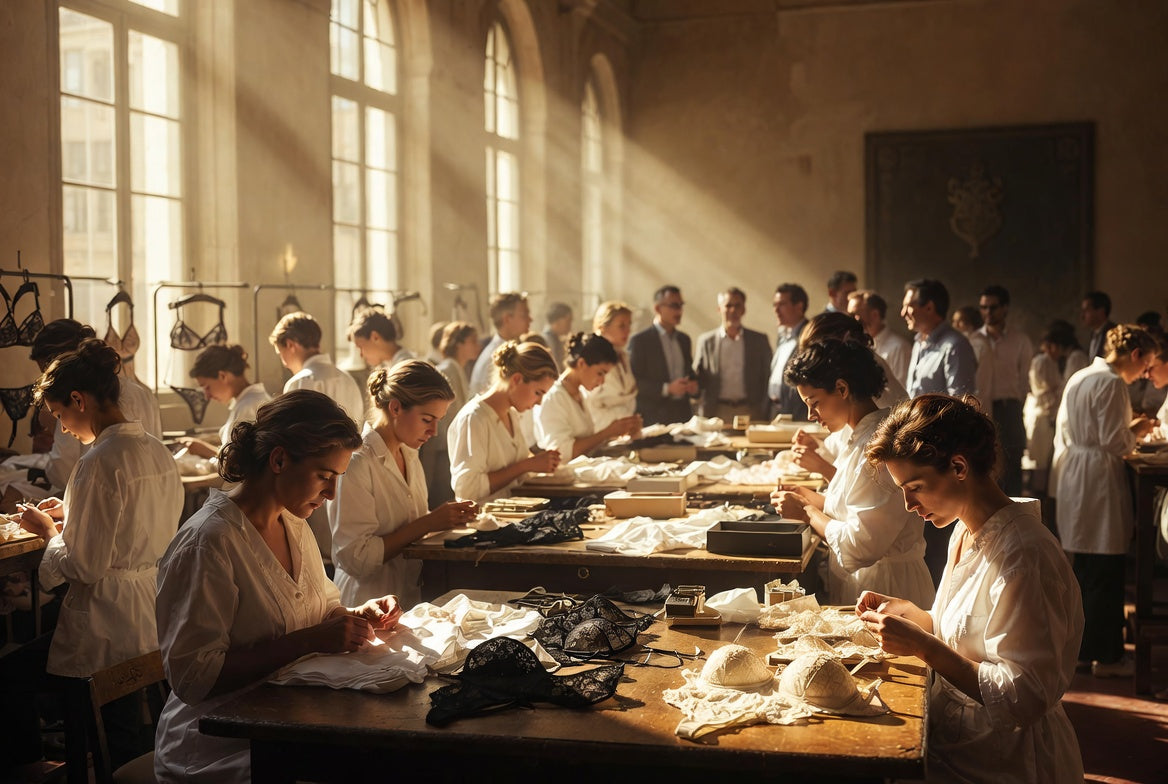
Known locally as the “Perlines,” La Perla’s workers refused to accept that one of Italy’s most recognizable lingerie houses would simply disappear. According to The Wall Street Journal, they campaigned for more than a year, lobbying politicians, appealing to European institutions and staging public demonstrations to keep attention on the brand and the jobs tied to it. At one point, they set up a workbench outside their closed atelier as a visual argument that they were still ready to work if someone would give the company a real future.
That distinction matters. In many industrial rescues, workers are framed mainly as victims of decline. At La Perla, they became active political agents in the survival effort. Their case was not just that they needed jobs, but that the craft itself needed saving. La Perla’s identity has always depended on skills that cannot be replicated instantly elsewhere: pattern-making, embroidery, fine finishing and the kind of fabric handling that turns delicate materials into structured garments. If those jobs vanished, the label could perhaps continue as a trademark or licensing vehicle, but it would lose the artisanal foundation that made it La Perla in the first place. That was the workers’ argument, and eventually it became the center of the turnaround story.
The breakthrough came when the Italian government helped broker a sale to American businessman Peter Kern and his wife, Kirsten Kern. Reuters reported in June 2025 that Italy selected Kern’s offer as the most favorable, with a plan that included about €30 million in investment by 2027, protection for roughly 210 existing employees and additional hiring on top of that base. The deal was presented not simply as a transfer of ownership, but as an industrial relaunch centered on Bologna production.
That choice immediately made La Perla stand out from many recent fashion rescues. The common playbook in troubled luxury has often been to preserve the brand image while hollowing out the manufacturing base. Kern’s pitch, by contrast, was tied to keeping production where La Perla’s identity was born. Reuters reported that the plan specifically aimed to revitalize the Bologna site and sustain the workforce there.
Peter Kern was already well known in business circles as the former chief executive of Expedia. But what made the La Perla acquisition unusual was that it did not read like a conventional deal driven only by balance-sheet logic. The Journal reported that the Kerns were longtime admirers of the brand and had a personal history with it; Peter Kern had reportedly made a habit of buying La Perla gifts for Kirsten Kern on Mother’s Day. The couple also spend time in Italy, where they own a vineyard, placing them at a closer emotional and geographic distance to the brand than a typical turnaround investor.
That does not guarantee success, of course. Fashion history is full of romantic investors who underestimated just how hard brand revivals can be. But La Perla’s new owners appear to have understood one thing that previous regimes struggled with: the difference between a luxury logo and a luxury product. The Journal reported that one major source of La Perla’s financial strain had been an oversized global retail footprint, including flagship stores in elite shopping districts that were often larger than the business really needed. In other words, the company spent heavily on the theater of luxury while the economics underneath grew weaker.
That mismatch is familiar across the sector. Over the past two decades, many heritage brands expanded as if prestige alone could justify endless square footage and global replication. But as consumer habits shifted and wholesale channels changed, the cost structures behind those empires became harder to sustain. For La Perla, whose true competitive advantage lay in craftsmanship rather than in sheer retail scale, that strategy proved especially punishing. The brand may have looked global, but its value still depended on people in Bologna making difficult garments well.
The new ownership has tried to reverse that logic.
By late 2025, the relaunch had produced a tangible milestone: workers were coming back. Coverage from Modaes and WWD reported that La Perla’s new owner had rehired all 220 former employees, bringing them back to the Bologna atelier as normal operations resumed. That rehiring was symbolically powerful because it validated the workers’ campaign. The people who had publicly fought for the label were no longer petitioners on the outside; they were again the hands making the product.
The Wall Street Journal’s reporting this week described a company now betting its future on that heritage. The seamstresses who returned to work include women with decades of experience, and the revival effort appears focused on restoring La Perla’s standing as a maker of hand-sewn, high-end intimate apparel rather than chasing a mass-market reinvention. The Kerns are reportedly supporting production ramp-ups, trunk shows and partnerships with Italian design schools to help train the next generation of artisans.
That last point may prove crucial. Saving La Perla is not only about restarting production; it is about preserving knowledge. Skilled lingerie construction is highly specialized. Unlike simpler apparel categories, intimate wear depends on exact fit, support, finishing and comfort, all while using fragile materials that leave little margin for error. In a luxury context, those demands become even more exacting. A house can rehire workers after bankruptcy, but if it does not invest in training successors, the revival risks becoming temporary. The Journal reported that collaborations with Italian design schools are part of the strategy, suggesting that La Perla’s owners understand the problem as generational as well as financial.
There is also the question of timing. La Perla is relaunching into a luxury market that has become more uneven, with consumers in many segments more cautious and brands under pressure to prove real differentiation. That could hurt a fragile turnaround. It could also help it. In an environment crowded with labels selling aspiration, a brand with authentic manufacturing heritage may have an opportunity to stand apart. The Journal noted that La Perla is leaning heavily into the hand-sewn quality that made its lingerie famous in the first place.
The company’s story also says something larger about “Made in Italy” at a moment when Europe is increasingly anxious about losing industrial identity even in prestige sectors. Italy’s role in the rescue was not incidental. Reuters reported that Industry Minister Adolfo Urso was involved in presenting Kern’s bid as the selected solution, underscoring how politically sensitive the fate of a heritage fashion employer had become. La Perla was not treated merely as a private commercial failure; it was treated as an industrial and cultural asset worth preserving.
And perhaps that is the core reason the rescue drew such attention. La Perla was never just another apparel company. It occupied a strange and valuable territory where craft, image, commerce and identity all met. The brand sold intimacy, but it also sold workmanship. It traded on glamour, but that glamour rested on specialized labor performed by workers who were rarely the public face of the label. In the bankruptcy phase, those workers became visible. In the rescue phase, they became indispensable.
There is still no guarantee that La Perla’s revival will become a textbook success. A respected name can still falter after a promising rescue. Costs can creep back. Demand can disappoint. Investors can lose patience. Fashion can be cruel to nostalgia when nostalgia is not backed by execution.
But for now, La Perla has achieved something more meaningful than a headline-friendly acquisition. It has restored continuity between the brand the world remembers and the people who actually made it worthy of remembrance. The Kerns may have supplied the capital and the ownership structure. The Italian government may have helped broker the path. Yet the force that kept the company alive long enough to be saved came from the workers who insisted that La Perla was not just a label to be liquidated, but a craft to be defended.
In an era when many fashion turnarounds are little more than logo management, that may be the most remarkable part of the story. La Perla was pulled back not only by money, but by memory, labor and stubbornness. A legendary brand survived because the seamstresses who knew its value refused to let the world forget it.